village
Welcome to The Training Village
Continuous testing of rodents in cognitive tasks
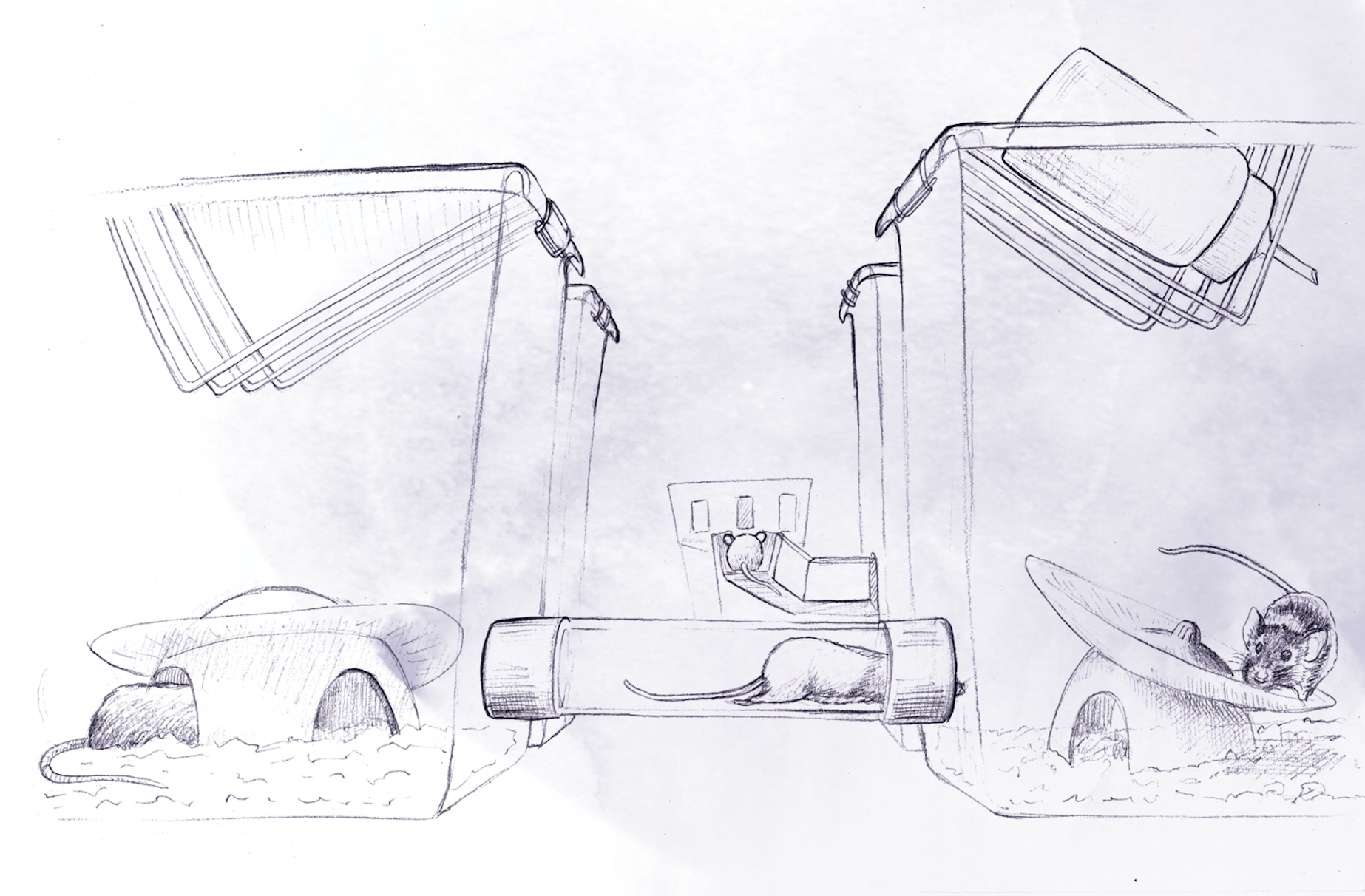
The Training Village is a system designed for the continuous, automated training of rodents in complex cognitive tasks. RFID-tagged animals live in groups and individually access an operant box to perform tasks at any time, 24/7.
|
|
Watch the System in Action
How Does It Work?
|
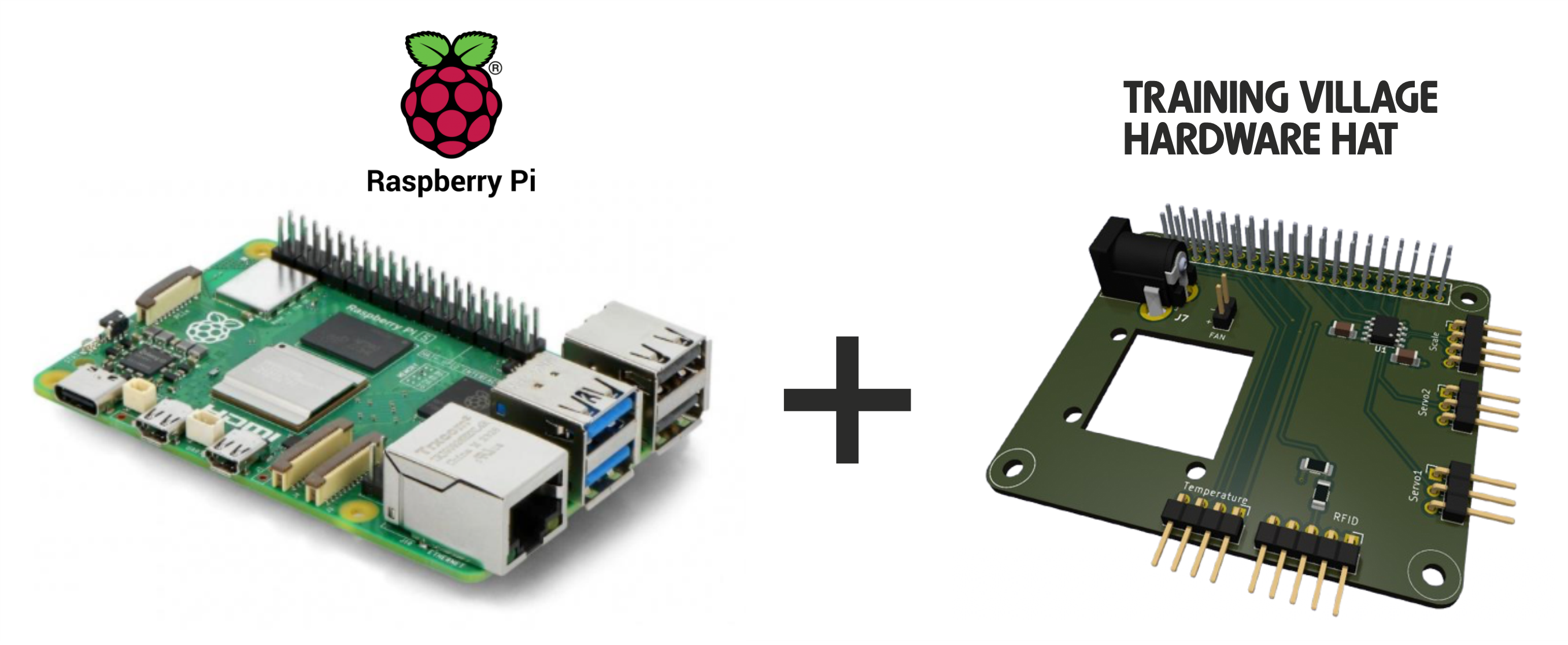
The system is managed by a Raspberry Pi, selected for its reliability, low power consumption, and efficiency. This core unit is equipped with a custom Plug-and-Play HAT (Hardware Attached on Top), which connects a set of custom PCBs distributing power and signals to the sensors and actuators throughout the system. |
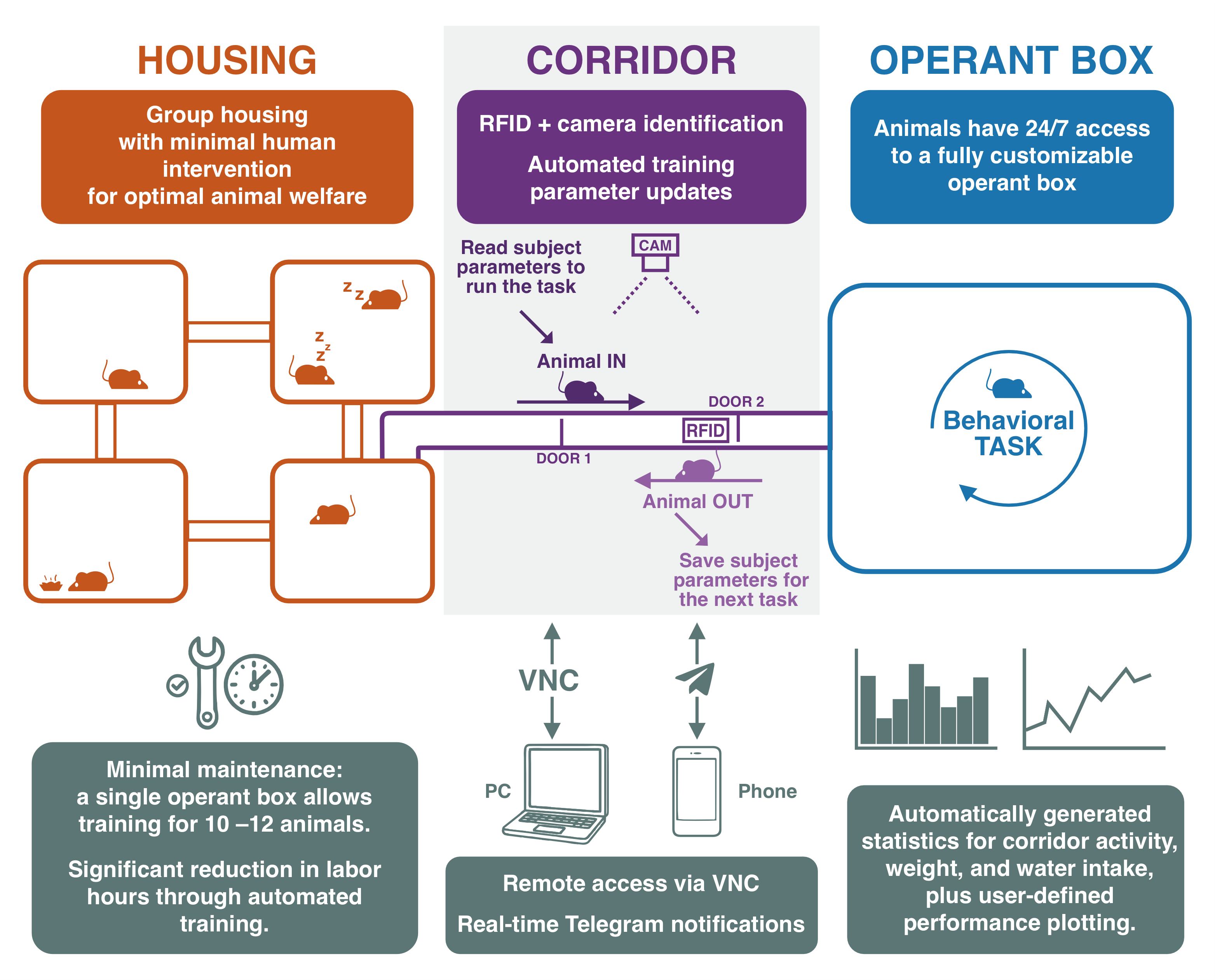
Social Living & Identification — Animals reside in social groups within one or more home cages. When an animal enters the access corridor, the setup utilizes RFID identification and a video camera to recognize the subject. A precision dual-door mechanism, orchestrated by the Raspberry Pi, ensures a controlled, single-animal entry into the Operant Box.
The Training Session — Once the animal is inside, the task logic and hardware—such as behavioral water ports—are typically managed by Bpod or Arduino. Simultaneously, the Raspberry Pi performs real-time camera-based tracking, allowing the animal's position to trigger specific experimental events. Additionally, it provides the high-level processing power required for peripherals like touchscreens or sound cards, ensuring stimulus presentation with negligible latency.
Return & Data Synchronization — After the session, the animal returns to its social group. All data is automatically synchronized to a server or external drive, and the training parameters for that specific subject are updated. This ensures the animal advances through its training protocols without any manual intervention.
Modular & Extensible — The platform is built to grow with your research:
System Usage
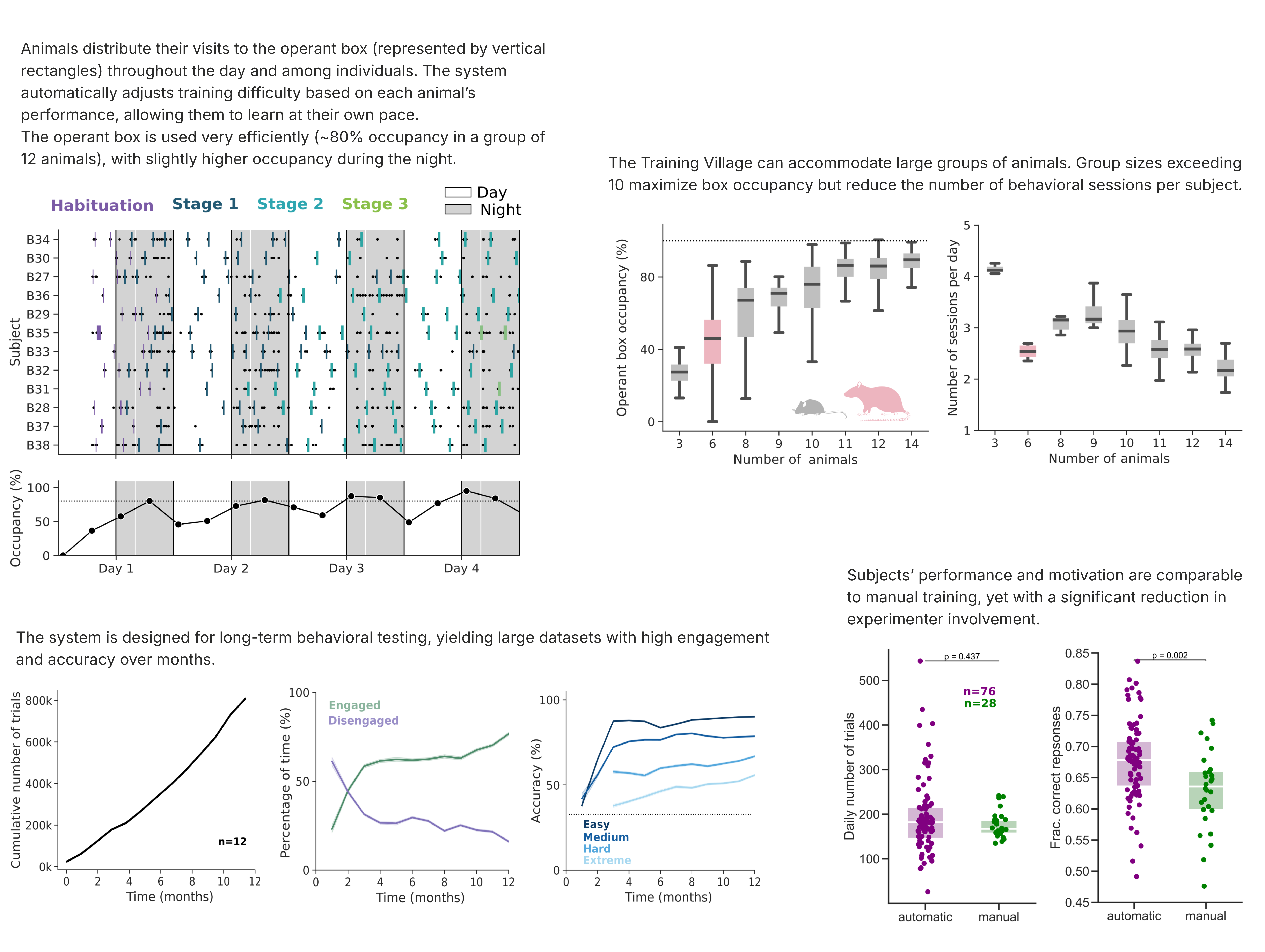
The Training Village has been rigorously tested in the Brain Circuits and Behavior Lab across multiple cohorts of mice and three distinct behavioral paradigms: a three-choice visuospatial delayed response task, a two-choice visual or auditory perceptual discrimination task, and a two-armed bandit task. The system has been successfully adapted to rats in the Animal Minds Lab.
Interested in the Training Village?
We are excited to share this platform with the neuroscience community. If you would like to implement the Training Village in your research or discuss custom configurations and quotes, please reach out to us at braincircuitsbehavior@gmail.com
How to Cite
If you use Training Village, please cite:
Serrano-Porcar, B., Marin, R., Rodríguez, J., Barezzi, C., Vasoya, H., Kean, D., Pottinger, D., Taylor, A., Martínez Vergara, H., & de la Rocha, J. (2026).
The Training Village: an open platform for continuous testing of rodents in cognitive tasks.
bioRxiv. https://doi.org/10.64898/2026.01.12.698970
Source Code
Training Village is fully open-source. You are welcome to explore the code, contribute, or report issues on our GitHub page.
Developed by:
BRAIN CIRCUITS AND BEHAVIOR LABFunding was provided by the Spanish State Research Agency (AEI), the European Research Council (ERC), and the Cellex Foundation.